by Patrick Jennings
Model photographs by James Jennings
(Click on the thumbnails to see the full-sized images)

The Nieuport 17 was one of the most successful and popular Allied fighters of World War I, known both for its excellent flying qualities and fighting ability. The Nieuport 17 became the favored mount of such well known aces as Bishop, Ball, Guynemer, and Nungesser. The success of Nieuport fighters, particularly the Nieuport 17, was maintained even against later German designs such as the Albatros D.I and early Halberstadt fighters.
The Nieuport 17 was derived from the Nieuport 11 ("B�b�" or baby), and the more powerful 110 h.p. variant of the Nieuport 11, the Nieuport 16. the Nieuport 17 ("Superb�b�") retained the 110 h.p. Le Rhône rotary power plant used in the Nieuport 16, and had wings of increased span and area. Due to the increase in wing area to approximately 15 square meters, the Nieuport 17 was also know as the Nieuport "15." Because the lower wing of the Nieuport 11 had a tendency to twist in a dive or during tight maneuvers, the Nieuport 17 had a stronger spar fitted in lower wing. Nieuport 17's were used by predominately by French and British units, but Nieuport 17's were also supplied to the Dutch Army Air Service and the Belgian Aviation Militaire. Nieuport 17's were also built in Russia and Italy. One hundred fifty Nieuport 17's were built under contract for the Italian air force by the Italian firm Macchi.


The Nieuport 17 model depicted in this review is shown in the color scheme used by Capitano Francesco Barraca, the top scoring ace (34 kills) of the Italian Air Force of World War I. Many of Barraca's victories were scored in Nieuports, but by the end of his career he was flying a Spad XIII. Unfortunately, Barraca did not survive the war; he was shot down on June 19, 1918, during a ground attack mission. In 1923, Barraca's prancing horse symbol was adopted by Enzo Ferrari at the encouragement of Countess Paolina Biancoli, Francesco Barraca's mother, for good luck.


The model is another excellent design by Marek Pacy�ski, and is distributed electronically by DeWayne Barnett as a single model in Adobe .PDF format. Currently, it does not appear that the model is available on CD. (Personally, I prefer receiving models by e-mail because my wife never discovers what I'm up to, since nothing arrives in the mail.) Since the model is only available in electronic form, it must be printed to card stock on a color printer.
The model consists of three sheets. The first page is a cover page showing color side and top views of the aircraft, and a picture of Francesco Barraca with biographical information. The second page contains a brief history of the Nieuport 17 and the specifications of the aircraft. The construction diagrams show part numbers, and the completed arrangement of parts in the model as formers, struts, spars, propeller, etc. Although these diagrams are the only guide to construction, they are all that is really required. If written construction guidelines are desired, the August 2003 issue of Card Modelers Online has basic construction tips for the model in the "First Looks" section. The final sheet contains the 98 parts needed to complete the model and a small scale profile assembly diagram for the rotary engine. Parts marked in red must be reinforced with heavy card stock.

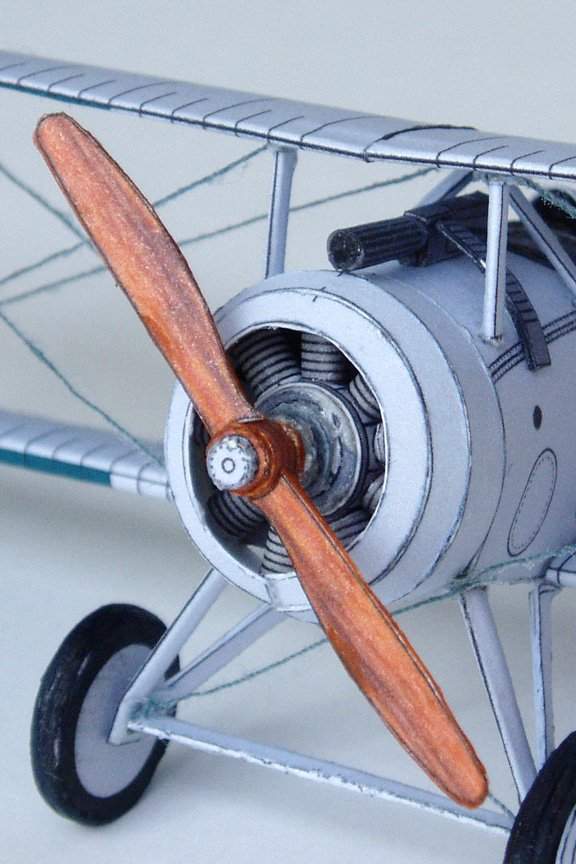

Construction is straightforward. Cut out the parts, reinforcing them as necessary. To complete the model, refer to the assembly diagrams and follow the basic assembly sequence outlined in the August 2003 issue of Card Modelers Online. I suggest building the engine, cockpit, propeller, and machine gun first, since they have the smallest parts and are the most complex and time consuming areas of the model. Be sure that you don't make the engine cylinders too long -- the engine cowl will be a tight fit if you do. Make the cockpit and lower wing spar as a subassembly before gluing it to the forward fuselage skin. Before gluing the underside of the fuselage (Part 5), make sure that there is room between the tabs on Part 5 to accept the lower wing spar (some trimming of the tabs may be necessary). I recommend using very thin toothpicks or wire to reinforce the spars for the wings and the landing gear. If you want to add bracing wires (an extra detail not included in the model), plan in advance and punch holes in the skin of the model before beginning construction. I used thin tread, but as the pictures reveal, the thread looks "all fuzzed up" under magnification. Use very fine, non-fuzzy thread (or perhaps fine fishing line) for bracing wire. I'm sure some of the more experienced modelers have suggestions along these lines.
The model is a simple but excellent design, and it looks great when it is done. Construction is not too difficult, but some building experience is suggested.
Summary
| Model: | Nieuport 17 |
| Kit: | Models by Marek |
| Designer: | Marek Pacy�ski |
| Scale: | 1:50 |
| Difficulty: | Beginner to intermediate |
| Number of Parts: | 98 |
| Instructions: | 5 diagrams |
| Fit: | Very good |
| Coloring and Artwork: | Very good |
| Comments or questions: | pjennings3@cox.net |
