Photos by the author
This, as many will realise is a kit from Micromodels and was published in the 1950/60's in London. Many of their kits are still available, even e-bay have had some for auction.
Comparison with many of today's kits shows how different this kit is. The first thing is the presentation. The kit comes as a series of postcards wrapped in a paper binder. Once cut open the binder has basic instructions printed on the inside. More instructions are printed on the 10 cards. This brings us on to the second major difference, the scale of the model. As the name implies, the pieces are of minute proportions. Some of the roofs are no more than a 1/8th of an inch long but are still made up of three pieces. Finally, the print quality is not as good as today's kits and this makes cutting and scoring an imprecise art. More of this later.
This is not intended to be an exhaustive construction review because most of the 40 odd buildings are made in exactly the same way. So I will try to give an idea of the problems that are general with models of this size.
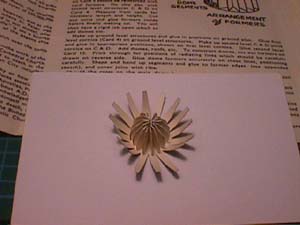
The instructions start off with the main dome of the cathedral. The 16 supports are glued inside the dome and to the base which is about � an inch in diameter. I was thinking about leaving these out but I am glad I didn't, it makes the shaping of the dome so much easier.
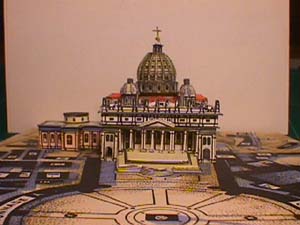
As you can see I've jumped on quite a bit since the first picture. Mainly because the building of St Marks is really a matter of gluing pieces into box shapes and gluing them together. The small ball and cross on the top is made from cotton thread. Dipping the thread into the PVA glue about six time and leaving it to dry between dips makes the ball.
A word of warning at this point. Do not glue on the Dome to the building until the end. I lost the top of the dome and cross some time in the build, and it's so small I never did find it. So I had to scratch build another few parts at the end.

Pic 3 This shows the base and one of the cards. As a reference I have included a 6-inch rule.
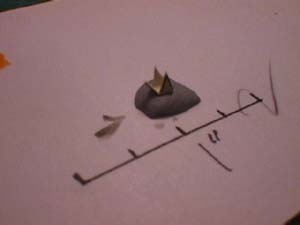
Here, I am trying to give an idea of size. The line is 1 inch long. I have held the base to a piece of card with "blue Tac" This is a substance like soft modeling clay that does not harden and is just sticky enough to hold the piece but can be removed without harming the card.
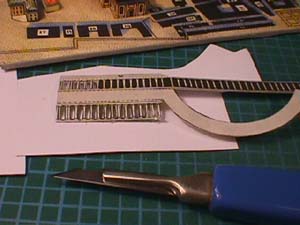
I really like making life difficult! Here is part of the colonnade that runs round the plaza in front of the cathedral. As you can see I decided to remove the black areas to give the part a see through look

As I mentioned in the introduction, some parts are very small. This is a good example. The Buildings are designed as six sided boxes but because of the small size and thick fold lines it is almost impossible to get all sides equal. I therefore cut off the base. It is the black piece with the number. By removing the base it is easier to even up the walls and thus have square buildings. Because of the scale cutting off even the smallest bit makes a huge difference.

Yet another small building, this is part of a 3 part building
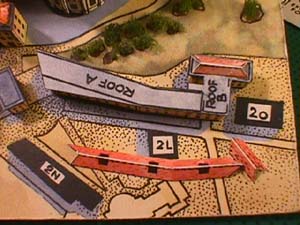
This shows one example of the instructions. As can be seen the roof parts have to be added in reveres order to enable a proper fit.
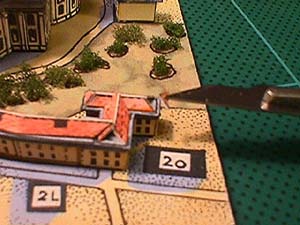
The blade is a 15A which is smaller than the more usual no 15. It seemed to be the easiest way to add the very small roof ends. Also, note the attempt at bush making in the background.
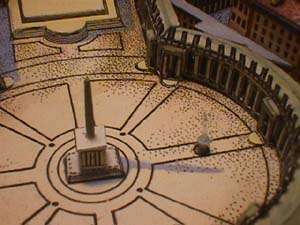
The instructions suggest that the column and the fountains are carved from matches. I thought that cocktail sticks would be better, they are denser and round, which gives a good start. I put the stick in a small hand drill and used it like a lathe. I used a craft knife to shape the three pieces. I used balsa cement to replicate the water.


Making this model shows that our hobby has not changed much in the last 40 or so years. The quality of printing has improved but little else has changed. The scale makes it difficult to produce a model that looks good in close up and it would take someone with more skill and patience than me to make a good job of this kit. On the other hand people who have seen the finished model seem impressed that I could make something this small. Size isn't every thing!!
