Part 1 - The Hull.
Editors note: This review will be in at least three parts due to the size of the model.
Photos by the reviewer

When Saul offered me the chance to review the Bismarck, I didn't realize what I was really letting myself in for, not particularly the complexity, but the sheer size of the model, the difficulty of handling such a large item, and the space needed for construction.
The Wilhelmshaven offering is not a new model, and this is reflected in the parts layout, and the way in which certain parts are constructed. The parts are printed on 16 A3 sheets, the quality being mostly good, but with slight variations, especially between the decking areas.
The model is so large, that I decided to do this review in three parts;
1) the hull - not particularly complicated, but causing problems due to the size
2) the superstructure - perhaps the most difficult parts
3) the armament - difficult, but mostly boring due to repetition.
I will be doing this review over 3 months, and this month, the first instalment - the hull. Firstly, a lot of planning has to be done on the sheer logistics on the building of this model. It over 39 inches ( 1000 mm) long, and over 5 inches ( 130 mm ) in beam. I had to search out a new building board, as mine was about 12 in. short. Eventually someone offered me a shelf, but the model only just fitted diagonally.
A generic instruction is included, as well as an English sheet, which helpfully details the parts needed for the two variations. Nowhere is there any mention that the frames should be laminated with thick card, and the decks doubled up, which is absolutely essential as the sheer length of the hull needs strength, and the decks need the extra thickness to keep smooth and level.
The Wilhelmshaven model may be constructed as the Bismarck, or as the Tirpitz. The difference being separate decking for various areas, and variations in armament. I decided on the Bismarck ( this has to be decided at an early stage.)
The standard egg box construction is used, albeit on a large scale, a central keel has two extra 'keels' in the amidships area, and frames slotted into the keels. Since all frames were laminated with thick card, the slots need to be enlarged, to allow easy assembly. It is better to have a slightly sloppy fit, as a tight fit may induce stresses, which may show up later on in the build.

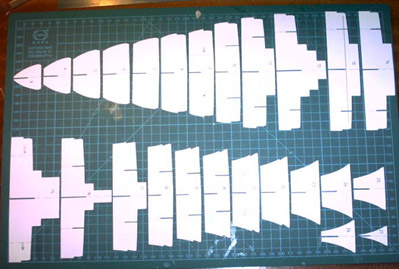
I used cyano to tack the frames together, then once I was satisfied that they were in the correct position completed the join with UHU. A major disadvantage with this is it takes several days for everything to dry out.
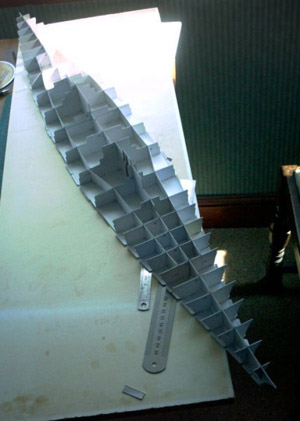
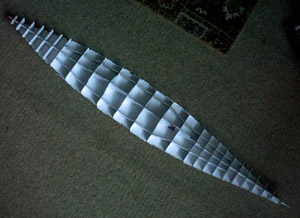


The deck is doubled up, the correct quarter deck selected, and the amid ships section cut as indicated to provide the Bismarck correctly. This where the differences in printing show up, and will require careful touching up to hide. The join is luckily under one of the twin 5.9" turrets. The deck is attached to the hull formers using tabs cut from spare card, trying to ensure a smooth run from bow to stern.
The hull plates, are attached to the formers, after careful bending to represent the armour belt. The forward hull plates are attached first to line up correctly with the hawse pipes on the fore deck. Again an attempt is made to give a smooth run from bow to stern. This proved very difficult, and I ended up with a few bumps that prove to be impossible to remove.
The bow and stern are finished off with closing plates that, possibly due to slight cutting errors, left a few gaps. These gaps are filled in with strips of card. Finally, the whole hull is touched up using water-colours and enamels.
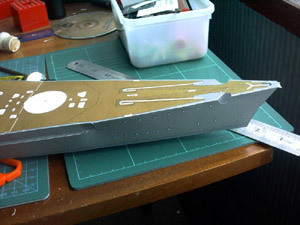
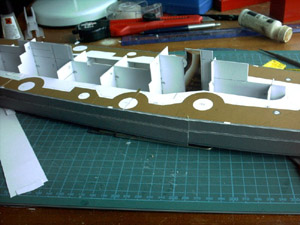

Well, the hull didn't prove that difficult, just the sheer size! My apologies for the poor quality of the photos, but my digicam packed up, and the camera I could borrow wasn't really up to it! This will be remedied shortly, as my new camera is being delivered later this week.
In the next instalment. I will move on to the superstructure.
Nigel Ward--Gloucestershire August - September 2002
This model is available at H&B Precision Card Models (Peter Heesch)H&B; Precision Card Models
